The gates
Torii gates Kyoto: where the ten thousand gates actually are
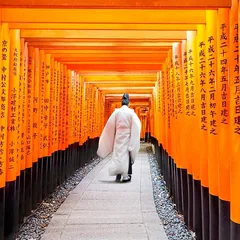
Almost every photograph labelled “torii gates Kyoto” was taken in the same place: a hundred-metre stretch behind the main hall at Fushimi Inari Taisha, in the south of the city, about five minutes by train from Kyoto Station. It is free, it never closes, and if you arrive at the wrong hour you will photograph the back of somebody’s head.
Quick answer
The torii gates in Kyoto are at Fushimi Inari Taisha, a Shinto shrine in the south of the city. About 10,000 vermilion gates line the paths up Mount Inari, and the famous dense double row behind the main hall is called Senbon Torii. Entry is free and the site is open 24 hours a day. Inari station on the JR Nara Line is two stops from Kyoto Station, roughly five minutes, and the entrance is directly opposite the exit.
The torii gates of Kyoto, at a glance
- Where
- Fushimi Inari Taishasouthern Kyoto, at the foot of Mount Inari
- How many
- About 10,000along roughly 4 km of mountain path
- The famous stretch
- Senbon Toriiover 1,000 gates in about 100 m
- Cost to enter
- Freeno ticket office anywhere on site
- Open
- 24 hoursno gate and no closing time
- Who pays for them
- Donorscompanies, families, shopkeepers
- A small gate costs
- ~¥400,000the large ones run past ¥1 million
- Colour
- Vermilionheld to ward off evil
- Quietest hour
- Before 8 amand again after dark, when they are lit
- Guided days from
- $50the gates themselves stay free
Where they are
Where are the torii gates in Kyoto?
One shrine, five minutes from Kyoto Station, and no ticket at the door.
At Fushimi Inari Taisha, in the Fushimi ward in the south of the city. This is worth being precise about, because Kyoto has more than a thousand shrines and almost all of them have a torii at the entrance. What Fushimi Inari has that no other site in Japan has is density: thousands of gates set a step apart, one after another, for kilometres.
Getting there is the easiest journey in Kyoto. From Kyoto Station take the JR Nara Line two stops to Inari — about five minutes, around a dollar, and covered by the Japan Rail Pass. The shrine entrance is directly across the road from the station exit; there is no walk and nothing to find. From Gion or Osaka, the Keihan Main Line to Fushimi-Inari station puts you five minutes away on foot.
The gates begin about ten minutes inside, behind the main hall. Before that you pass the Romon gate, a courtyard and a stage, all of them vermilion and none of them the thing you came for. Keep walking.
What they are
Six things about the torii gates worth knowing before you stand under them
The gates make far more sense once somebody explains what they are for.
- A torii marks a boundary
It separates ordinary ground from sacred ground. Passing under one is the point of it — that is why they stand over a path rather than beside it.
- Every gate here was donated
Not built by the shrine. A company, a family or a shopkeeper pays for one, usually in thanks for a wish granted or in hope of the next one.
- The black writing is a name and a date
Painted down the right-hand leg: the donor and the day the gate went up. Walk slowly and you are reading a directory of Kyoto businesses going back decades.
- They cost real money
A modest gate at the narrow upper end starts around four hundred thousand yen. The large ones down where everybody walks run past a million.
- The colour has a job
Vermilion — shu — is held to repel evil, and the traditional pigment contained mercury, which preserved the wood. Belief and chemistry arriving at the same answer.
- They are constantly replaced
Cedar rots in the Kyoto damp. Walk the upper paths and you pass bare new posts waiting to be raised beside gates whose paint is peeling off in sheets.
If you want the gates without the crowd, the hour matters more than anything else on this page — and only one tour here arrives before eight.
The hour to arrive, in detail→Senbon Torii
What is Senbon Torii, and how long is it?
A hundred metres, two parallel tunnels, and the only crowded part of the mountain.
Senbon torii means “thousand torii”, and the name is not far off: there are more than a thousand gates in the dense stretch behind the main hall. It runs for roughly a hundred metres and splits into two parallel tunnels that rejoin at the far end.
Custom is to take the right-hand tunnel going up and the left coming down, and almost everybody does. That is useful to know for a practical reason as well as a polite one: the left-hand tunnel usually has fewer people in it, which matters if you are trying to photograph an empty path.
At the top of Senbon Torii is the Okusha, a small shrine with two stone lanterns beside it called omokaru-ishi, the heavy-light stones. Make a wish and lift the round stone on top. Lighter than you expected means the wish will be granted; heavier means not yet. There is usually a short queue for this and it moves quickly.
Everything above the Okusha is where the shrine changes character. The gates continue, but they thin out, the crowd thins faster, and within ten minutes you are walking through cedar forest past small stone altars that nobody photographs at all.
Every trip, current fare
Tours that take you to the torii gates
The gates are free to walk under, so what these twelve buy is the rest of the day. Cheapest first, with the other stops each one reaches.
| Tour | Length | Price | Other stops | Cost per hour | Rating |
|---|---|---|---|---|---|
| Nara, Fushimi Inari & Arashiyama Bus TourThree sights, one coach, the lowest price here | 9–10 h | $50 | Nara, Arashiyama | $5.26 | 4.8 · 3,168 |
| Early Morning Fushimi Inari & ArashiyamaThe only one that beats the crowd to the gates | 6 h | $62 | Arashiyama, Kinkakuji | $10.33 | 4.9 · 1,597 |
| Kyoto by Bus: Nijo, Bamboo Grove & Fushimi InariNijo Castle and the bamboo, in English or Spanish | 11 h | $62 | Nijo, bamboo grove | $5.64 | 4.7 · 761 |
| Crowd-Free Kyoto: Fushimi Inari, Nijo & KinkakujiFive hours, and built around the early start | 5 h | $67 | Nijo, Kinkakuji | $13.40 | 4.5 · 23 |
| Private Tour: Fushimi Inari & BambooA licensed guide for your group alone | 3.5–6 h | $68 | Arashiyama bamboo | $14.32 | 4.9 · 6 |
| Kyoto Bus Tour: Fushimi, Kiyomizu, Kinkakuji & ArashiyamaThe five names everybody knows, in one day | 10 h | $81 | Kiyomizu, Kinkakuji, Arashiyama | $8.10 | 5.0 · 72 |
| Kyoto Full-Course: 10 Must-SeesTen stops for a single day in Kyoto | 9.5 h | $92 | Ten in total | $9.68 | 4.9 · 194 |
| Fushimi Inari, Kinkakuji & Bamboo GroveSix sights with every entry ticket included | 8.5–9 h | $93 | Kiyomizu, Kinkakuji, bamboo | $10.63 | 4.8 · 5,297 |
| Full-Day City Highlights Bike TourThe whole city by bicycle, lunch included | 8 h | $171 | Gion, Kiyomizu, bamboo | $21.38 | 4.9 · 56 |
| Customized Private Tour with Licensed GuideA licensed guide, and the route is yours | 4–8 h | $201 | Your choice | $33.50 | 4.8 · 523 |
| Private Highlights Tour with Guide and VehicleA car and driver for the whole day | Full day | $295 | Your choice | $36.88 | 4.9 · 121 |
| Private Highlights Tour with Guide and VehicleA driver-guide, and you write the itinerary | Full day | $415 | Your choice | $51.88 | 4.6 · 471 |
Photographing them
How to photograph the torii gates without a hundred strangers in the frame
This is the single most common disappointment at Fushimi Inari, and it is entirely avoidable.
- Be there before eight
The crowd arrives with the first coaches around eight and does not thin until late afternoon. At seven the tunnel is silent. This is the whole trick and there is no substitute for it.
- Or come after dark
The lower path is lit by lanterns, the gates glow, and there may be twenty people on the whole stretch. It is a completely different photograph and arguably a better one.
- Use the left-hand tunnel coming down
Everyone goes up the right. The left one is quieter simply because of that convention.
- Walk ten minutes past the Okusha
The gates continue well above Senbon Torii and almost nobody follows them. Same gates, no people, and you will have the path to yourself.
- Do not use a tripod in the tunnel
It is a working shrine and a narrow path. Handheld, wide, and step aside when someone comes through.
- Shoot upwards as well as along
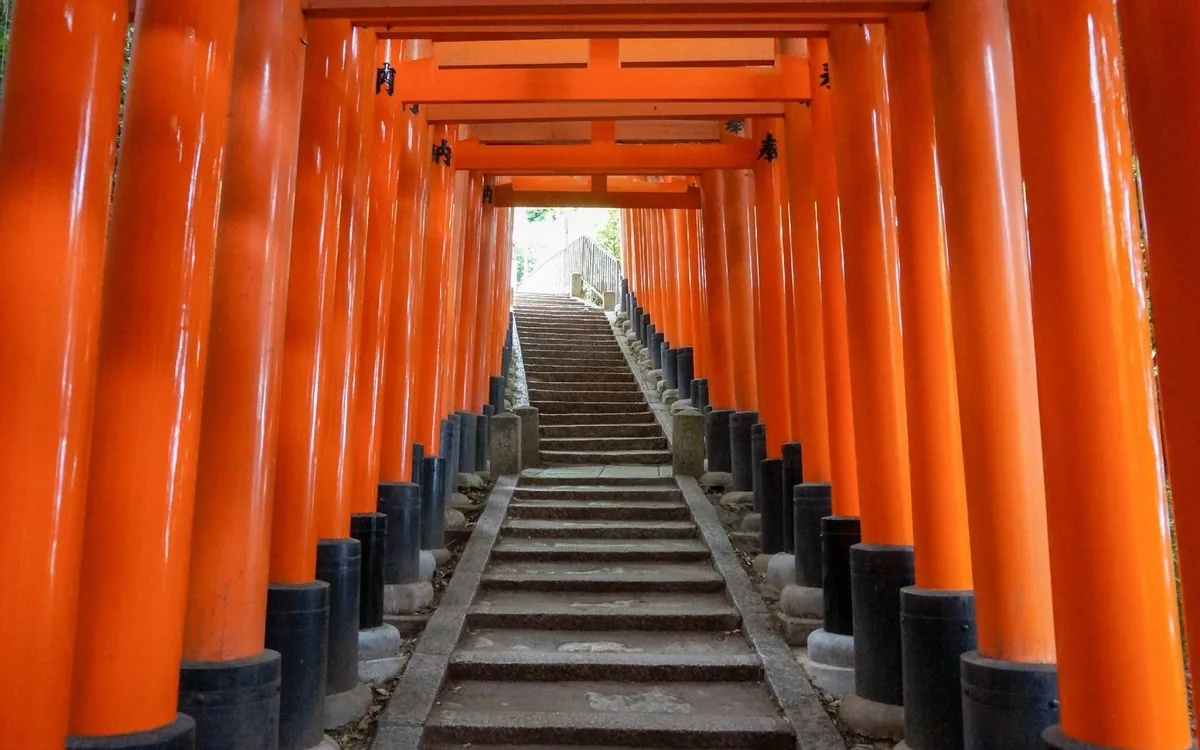
The lintels overlapping into the distance are the shot everybody takes. The view straight up through the beams is the one almost nobody does.
Common questions
The torii gates of Kyoto, answered
Where are the torii gates in Kyoto?
At Fushimi Inari Taisha, a Shinto shrine in the south of the city at the foot of Mount Inari. Inari station on the JR Nara Line is two stops and about five minutes from Kyoto Station, and the entrance is directly opposite the station exit.
How many torii gates are there in Kyoto?
About ten thousand, all of them at Fushimi Inari Taisha and spread along roughly four kilometres of mountain path. The dense stretch behind the main hall, Senbon Torii, holds more than a thousand of them in about a hundred metres.
Do you have to pay to see the torii gates?
No. Fushimi Inari Taisha is free to enter, there is no ticket office, and the gates are on open shrine paths that never close. The train from Kyoto Station costs about a dollar.
How long does it take to walk through the torii gates?
Senbon Torii itself takes about ten minutes at a walking pace, longer if you are photographing it. Reaching the Yotsutsuji viewpoint halfway up takes thirty to forty-five minutes, and the full loop of Mount Inari takes two to three hours.
Why are torii gates orange?
The colour is vermilion, shu in Japanese, and it is traditionally held to ward off evil. The historic pigment also contained mercury, which preserved the wood against rot — so the colour was doing two jobs at once.
What is written on the torii gates?
The name of the person or company who paid for the gate, and the date it was raised, painted in black down the right-hand leg. Every gate on the mountain was a donation.
Can you walk through the torii gates at night?
Yes. There is no closing time and the lower section is lit by lanterns. It is one of the few famous sights anywhere that is genuinely better after dark, mostly because almost nobody is there.
Are the torii gates in Kyoto worth visiting?
Yes, with one condition: go early or late. At eleven in the morning in November it is a queue moving at walking pace through a hundred metres of gates. At seven in the morning it is the single most striking place in Kyoto, and it costs nothing.
Go deeper
More on Fushimi Inari Taisha
Fushimi Inari Shrine
What it is, what it costs, and the hour to arrive.
By colourThe red gates of Kyoto
What they are called, and the three other red buildings people mean.
ToursWhich tour is worth it
Six compared, and the two situations where a tour earns its price.
CostTickets and entrance fee
There are none. What a visit actually costs, and why other sights charge.
HoursWhen it is open
It never closes. Hour by hour, and when the crowd arrives.
Getting thereFrom Kyoto in five minutes
JR Nara Line, two stops, about a dollar, covered by the JR Pass.