Nov
Late November
Maple colour on the lower slopes, cool air for the climb, and low warm light through the gates. Also the busiest month, so start before eight.
The climb
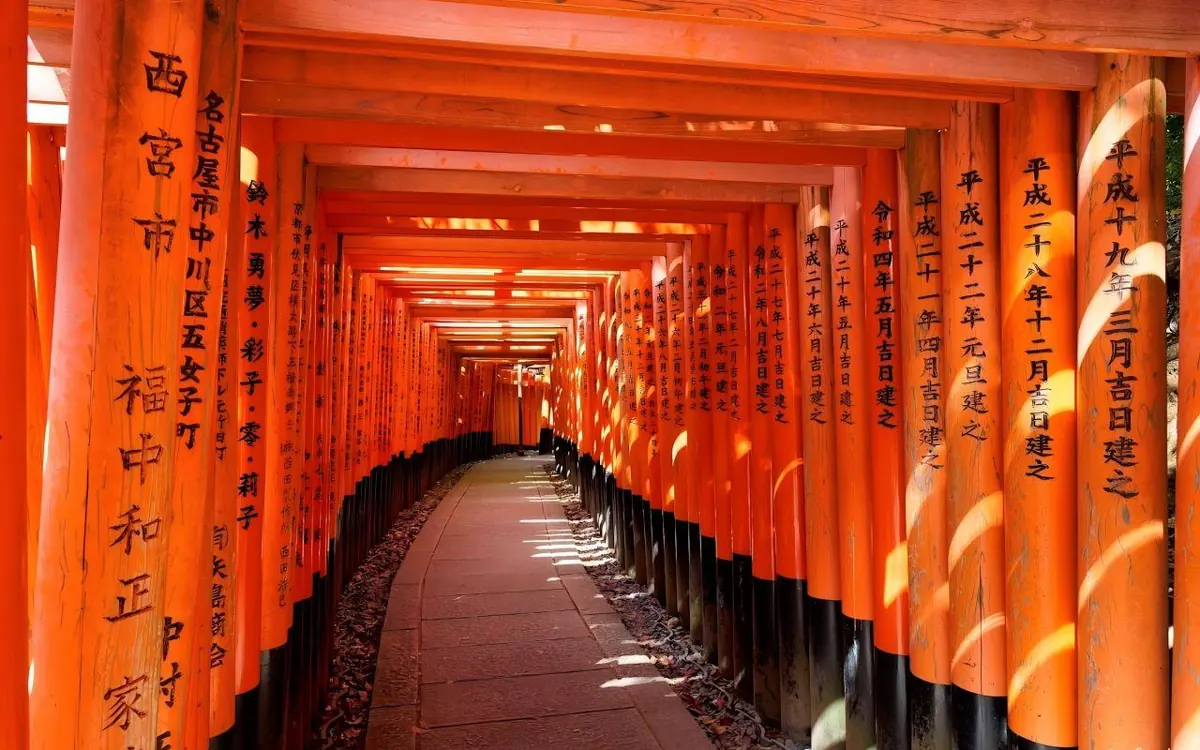
Almost everyone who walks into Fushimi Inari photographs the first hundred metres of gates and leaves. Above them is a four-kilometre loop over a 233-metre mountain, lined with gates the whole way, and on most days you will have long stretches of it entirely to yourself. It is free, it is open at any hour, and the only thing it asks is that you are wearing something you can climb stone steps in.
Quick answer
The full hike at Fushimi Inari is about 4 kilometres and takes 2 to 3 hours from the entrance and back. The Yotsutsuji crossroads, roughly halfway, is 30 to 45 minutes up and is where most people stop — it has the only view over Kyoto. The path is stone steps rather than a graded trail, it is free at every hour, and the crowd thins dramatically within ten minutes of leaving the famous tunnels.
How long
Twenty minutes, ninety minutes, or three hours. All three are reasonable choices.
It depends entirely on where you stop, and there are three sensible answers.
Twenty minutes gets you through Senbon Torii to the Okusha shrine at the top of the dense tunnels and back down. This is what the coach tours allow and what most visitors do. You will have seen the famous photograph and roughly a tenth of the gates.
Ninety minutes round trip gets you to Yotsutsuji, the crossroads about halfway up. Thirty to forty-five minutes of climbing each way. This is the honest recommendation for most people: it is the only place on the mountain with a view over Kyoto, there are teahouses and benches, and the crowd has largely gone by the time you arrive.
Two to three hours does the full loop over the summit and back. About four kilometres. There is no view at the top — the trees close over it — and the reward is the quiet, the moss, and several hundred small stone altars that almost nobody sees.
Add time in summer. The mountain holds heat and humidity badly and the steps are relentless; a climb that takes thirty-five minutes in November can take fifty in August.
Doing it well
None of them are difficult and all of them are learned the hard way otherwise.
It is stone steps for four kilometres. Sandals and a rented kimono get as far as the first tunnel, and you will watch several people discover this.
There are vending machines on the way up and the prices climb with the path. The convenience store by Inari station is the sensible last stop.
The mountain is a genuine climb in August heat. Before eight is cooler as well as emptier.
That is where the crowd density collapses. If you have only half an hour to spare, spend it climbing past the point where everyone stops rather than queueing where they are.
It has the only view, teahouses, and somewhere to sit. Turning around there is a choice rather than a failure.
Stone steps, worn smooth, often wet. Allow the same time down as up, and more in rain.
No coach tour climbs past the Okusha — they allow sixty to ninety minutes at the shrine. The mountain is something you do on your own morning.
Which hour to give it→The top
No view at the top. Thousands of small altars, and almost nobody else on the path.
Honestly: only if you want the walk rather than the view, because there is no view. The summit of Mount Inari is 233 metres, wooded, and enclosed. Nothing opens up. Anyone telling you the climb ends in a panorama over Kyoto is describing Yotsutsuji, which is halfway.
What the upper mountain has instead is emptiness and accumulation. The path passes through clusters of small stone altars — otsuka — erected by worshippers over centuries, thousands of them, mossed over and stacked against each other in the cedar shade. There are fox statues with scrolls and jewels and keys in their mouths, and no crowd to photograph them.
For a lot of visitors that is the best hour they spend in Kyoto, precisely because it is the opposite of what the city is famous for. For others it is forty minutes of steps to see trees. Both reactions are common and honest, and Yotsutsuji is the compromise that satisfies nearly everybody.
When to climb
The shrine never closes, so this is about temperature and light rather than access.
Nov
Maple colour on the lower slopes, cool air for the climb, and low warm light through the gates. Also the busiest month, so start before eight.
Dec – Feb
Cold, clear and quiet. The best conditions for the climb itself, and snow on the gates a few times a winter is the single finest sight this shrine offers.
Mar – Apr
Comfortable walking weather and long light. Kyoto is full, but the upper mountain never is and the crowd stays at the bottom.
May – Jun
Warm and increasingly humid. Still very walkable if you start early; carry more water than you think you need.
Jul – Aug
Hot and humid, and the mountain holds it. A climb that takes thirty-five minutes in autumn can take fifty. Dawn or after dark, or not at all.
Every trip, current fare
Twelve tours, cheapest first. None of them climb past the Okusha — the mountain is something you do on your own time, and it costs nothing.
| Tour | Length | Price | Other stops | Cost per hour | Rating |
|---|---|---|---|---|---|
| Nara, Fushimi Inari & Arashiyama Bus TourThree sights, one coach, the lowest price here | 9–10 h | $50 | Nara, Arashiyama | $5.26 | 4.8 · 3,168 |
| Early Morning Fushimi Inari & ArashiyamaThe only one that beats the crowd to the gates | 6 h | $62 | Arashiyama, Kinkakuji | $10.33 | 4.9 · 1,597 |
| Kyoto by Bus: Nijo, Bamboo Grove & Fushimi InariNijo Castle and the bamboo, in English or Spanish | 11 h | $62 | Nijo, bamboo grove | $5.64 | 4.7 · 761 |
| Crowd-Free Kyoto: Fushimi Inari, Nijo & KinkakujiFive hours, and built around the early start | 5 h | $67 | Nijo, Kinkakuji | $13.40 | 4.5 · 23 |
| Private Tour: Fushimi Inari & BambooA licensed guide for your group alone | 3.5–6 h | $68 | Arashiyama bamboo | $14.32 | 4.9 · 6 |
| Kyoto Bus Tour: Fushimi, Kiyomizu, Kinkakuji & ArashiyamaThe five names everybody knows, in one day | 10 h | $81 | Kiyomizu, Kinkakuji, Arashiyama | $8.10 | 5.0 · 72 |
| Kyoto Full-Course: 10 Must-SeesTen stops for a single day in Kyoto | 9.5 h | $92 | Ten in total | $9.68 | 4.9 · 194 |
| Fushimi Inari, Kinkakuji & Bamboo GroveSix sights with every entry ticket included | 8.5–9 h | $93 | Kiyomizu, Kinkakuji, bamboo | $10.63 | 4.8 · 5,297 |
| Full-Day City Highlights Bike TourThe whole city by bicycle, lunch included | 8 h | $171 | Gion, Kiyomizu, bamboo | $21.38 | 4.9 · 56 |
| Customized Private Tour with Licensed GuideA licensed guide, and the route is yours | 4–8 h | $201 | Your choice | $33.50 | 4.8 · 523 |
| Private Highlights Tour with Guide and VehicleA car and driver for the whole day | Full day | $295 | Your choice | $36.88 | 4.9 · 121 |
| Private Highlights Tour with Guide and VehicleA driver-guide, and you write the itinerary | Full day | $415 | Your choice | $51.88 | 4.6 · 471 |
Common questions
Two to three hours for the full four-kilometre loop from the entrance and back. Thirty to forty-five minutes each way to Yotsutsuji, the halfway crossroads, which is where most people stop.
Moderate rather than hard, but it is stone steps for the whole way rather than a graded path. Anyone reasonably fit will manage it; anyone in sandals or with bad knees will find the descent harder than the climb.
There is no official count and estimates vary widely, because the path is a continuous mix of steps and slopes rather than a single staircase. The useful number is the time: thirty to forty-five minutes to Yotsutsuji.
No. The summit is wooded and enclosed. The view over Kyoto is at Yotsutsuji, roughly halfway up, and that is the destination most people actually want.
Yes, though not at the density of Senbon Torii. Gates line most of the loop, thinning and clustering, all the way over the summit and back down.
Yes. There is no closing time. The lower section is lit by lanterns; above Yotsutsuji it is genuinely dark and you would want a torch and some confidence.
No, but you do need closed shoes with a sole. Trainers are fine. The steps are worn smooth in places and the descent in rain is the part that catches people out.
Completely. The whole mountain is part of the shrine, there is no ticket at any point, and the paths are open 24 hours a day.
Go deeper
What it is, what it costs, and the hour to arrive.
The gatesWhere the ten thousand gates are, and how to photograph them empty.
By colourWhat they are called, and the three other red buildings people mean.
ToursSix compared, and the two situations where a tour earns its price.
CostThere are none. What a visit actually costs, and why other sights charge.
HoursIt never closes. Hour by hour, and when the crowd arrives.
Nara, Fushimi Inari & Arashiyama Bus Tour
★ 4.9 · 646 reviews · Free cancellation 24 h