Nov
Late November
Maple colour on the lower slopes and the low warm light that suits vermilion better than any other month. It is also the busiest month of the year in Kyoto, so this only works if you are at the first gate before eight.
Timing
Every other Kyoto sight is a question of season. Fushimi Inari is a question of the clock. It never closes and it costs nothing, so nothing about access changes across the year — but the difference between arriving at seven in the morning and eleven is the difference between an empty tunnel of gates and a queue moving at walking pace.
Quick answer
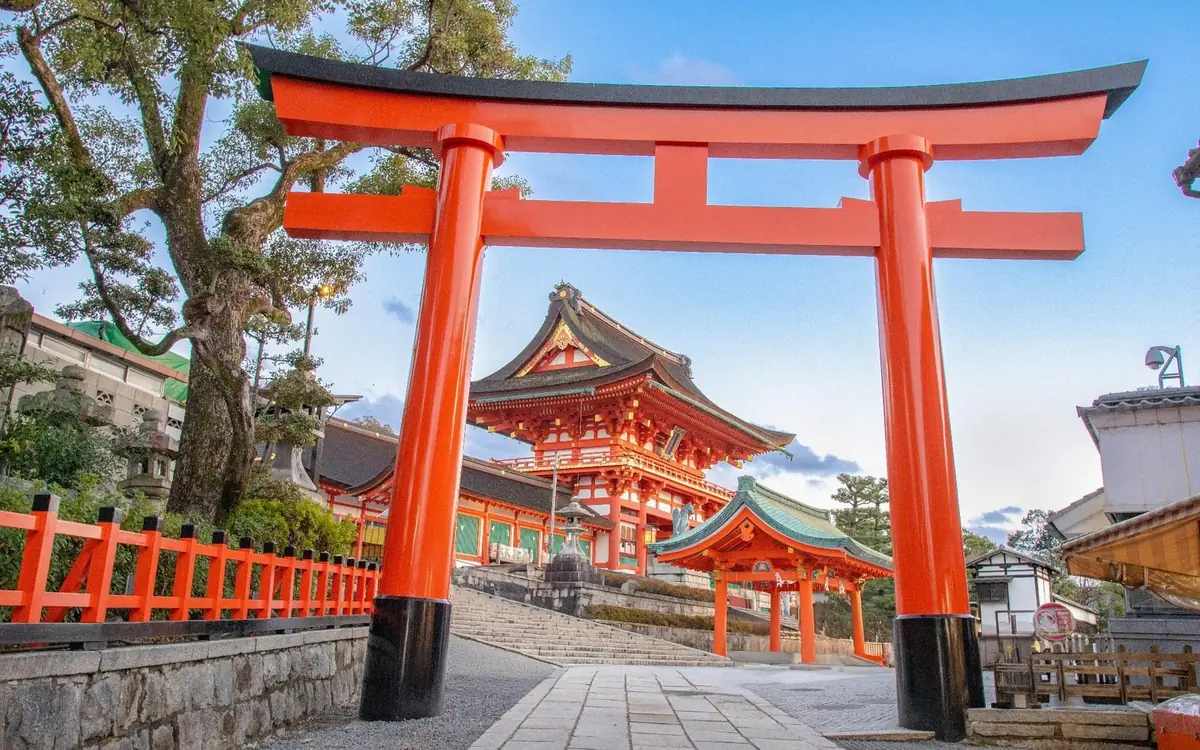
The best time to visit Fushimi Inari Taisha is before 8 am. The crowd arrives at about eight with the first coaches and does not thin until late afternoon, and the site is free and open 24 hours, so an early arrival costs nothing extra. After 5 pm is the second window, and after dark the lower path is lantern-lit and nearly empty. The best month is late November for the maple colour, and winter for the quiet.
The hour
Before eight, or after five. Everything between is a queue.
Before eight in the morning, and it is not close. This one decision changes the visit more than the season, the weather, the tour you book or the camera you carry.
The mechanics are simple. Fushimi Inari has no timed entry and no capacity limit, so the crowd is governed purely by when people can get there. The first coach tours and the first trains full of day-trippers arrive at about eight. By ten the site is at capacity in practical terms, and it stays that way until about three. Between four and six the day-trippers leave for dinner. After dark there is almost nobody.
So there are two good windows, and one of them is easy. Early morning is the better of the two — daylight, legible inscriptions, and the option of climbing the mountain — and it costs an alarm clock. The first JR train from Kyoto Station runs at about half past five, which puts you under the gates before dawn if you want that.
The evening window is easier to arrange and nearly as effective. Arrive at four, walk up to Yotsutsuji in daylight, come down as the lanterns come on. Two hours, one train fare, and you will have seen the shrine in two completely different lights.
By month
The shrine is open every day of the year, so this is about light, temperature and how many other people had the same idea.
Nov
Maple colour on the lower slopes and the low warm light that suits vermilion better than any other month. It is also the busiest month of the year in Kyoto, so this only works if you are at the first gate before eight.
Dec – Feb
Cold, clear and genuinely quiet outside the first days of January. The best conditions for the climb, the cheapest beds in Kyoto, and a few times each winter snow settles on the gates, which is the finest thing this shrine ever looks like.
Mar – Apr
Kyoto is at its fullest and Fushimi Inari is not even a blossom site, so the crowd here is spillover rather than purpose. Still busy from mid-morning. The upper mountain stays calm.
May – Jun
Warm, increasingly humid, and green. Comfortable if you start early; the rainy season in June brings wet steps and, as compensation, noticeably fewer people.
Jul – Sep
Hot and humid, and the mountain path holds it. The gates are as good as ever but the climb is work. Dawn or after dark, and carry more water than you think you need.
Beating the crowd
All six are free, and the first one is worth more than the other five together.
There is no substitute. The first train from Kyoto Station is around half past five and the journey takes five minutes.
The lower path is lantern-lit and there may be twenty people on it. A completely different photograph and an easier plan to keep.
The crowd density collapses past the point where everyone turns around. Same gates, no people, and it costs ten minutes of steps.
Custom sends everyone up the right. The left is quieter simply because of that.
Wet vermilion against wet green is better than the dry version, and a good proportion of the crowd stays away.
Hatsumode brings over two million people across three days. Extraordinary if that is why you came; impossible if it is not.
Only one tour on this site arrives before the crowd — the six-hour morning run. Everything else lands after eight.
Which tour gets there first→Every trip, current fare
Twelve tours, cheapest first. The length column is really an arrival time: the six-hour morning tour is the only one that beats the crowd.
| Tour | Length | Price | Other stops | Cost per hour | Rating |
|---|---|---|---|---|---|
| Nara, Fushimi Inari & Arashiyama Bus TourThree sights, one coach, the lowest price here | 9–10 h | $50 | Nara, Arashiyama | $5.26 | 4.8 · 3,168 |
| Early Morning Fushimi Inari & ArashiyamaThe only one that beats the crowd to the gates | 6 h | $62 | Arashiyama, Kinkakuji | $10.33 | 4.9 · 1,597 |
| Kyoto by Bus: Nijo, Bamboo Grove & Fushimi InariNijo Castle and the bamboo, in English or Spanish | 11 h | $62 | Nijo, bamboo grove | $5.64 | 4.7 · 761 |
| Crowd-Free Kyoto: Fushimi Inari, Nijo & KinkakujiFive hours, and built around the early start | 5 h | $67 | Nijo, Kinkakuji | $13.40 | 4.5 · 23 |
| Private Tour: Fushimi Inari & BambooA licensed guide for your group alone | 3.5–6 h | $68 | Arashiyama bamboo | $14.32 | 4.9 · 6 |
| Kyoto Bus Tour: Fushimi, Kiyomizu, Kinkakuji & ArashiyamaThe five names everybody knows, in one day | 10 h | $81 | Kiyomizu, Kinkakuji, Arashiyama | $8.10 | 5.0 · 72 |
| Kyoto Full-Course: 10 Must-SeesTen stops for a single day in Kyoto | 9.5 h | $92 | Ten in total | $9.68 | 4.9 · 194 |
| Fushimi Inari, Kinkakuji & Bamboo GroveSix sights with every entry ticket included | 8.5–9 h | $93 | Kiyomizu, Kinkakuji, bamboo | $10.63 | 4.8 · 5,297 |
| Full-Day City Highlights Bike TourThe whole city by bicycle, lunch included | 8 h | $171 | Gion, Kiyomizu, bamboo | $21.38 | 4.9 · 56 |
| Customized Private Tour with Licensed GuideA licensed guide, and the route is yours | 4–8 h | $201 | Your choice | $33.50 | 4.8 · 523 |
| Private Highlights Tour with Guide and VehicleA car and driver for the whole day | Full day | $295 | Your choice | $36.88 | 4.9 · 121 |
| Private Highlights Tour with Guide and VehicleA driver-guide, and you write the itinerary | Full day | $415 | Your choice | $51.88 | 4.6 · 471 |
Common questions
Before 8 am. The crowd arrives at about eight with the first coaches and does not thin until late afternoon. Since the shrine is free and never closes, arriving early costs nothing but an alarm.
Late November for the maple colour and the low warm light, though it is also the busiest month. December to February is the quietest and the best for the climb, and snow on the gates a few times each winter is the finest sight here.
Arrive before eight or after five, climb ten minutes above the Okusha where almost nobody follows, use the left-hand tunnel coming down, or come in the rain. All four are free.
It is busy every day between about ten and three. The seasonal peaks are late November and the first week of April, and the first three days of January are in a category of their own with more than two million visitors.
Yes, and it is arguably the best season. Cold, clear, quiet, cheap, and the occasional snowfall on vermilion gates is the photograph everyone else is missing.
Twenty minutes if you only want Senbon Torii. Ninety minutes round trip for Yotsutsuji and the view over Kyoto. Two to three hours for the full loop of the mountain.
Better than most people expect. There is nothing to close, the gates shelter much of the path, wet vermilion against wet green photographs well, and a useful share of the crowd stays away.
Go deeper
What it is, what it costs, and the hour to arrive.
The gatesWhere the ten thousand gates are, and how to photograph them empty.
By colourWhat they are called, and the three other red buildings people mean.
ToursSix compared, and the two situations where a tour earns its price.
CostThere are none. What a visit actually costs, and why other sights charge.
HoursIt never closes. Hour by hour, and when the crowd arrives.
Nara, Fushimi Inari & Arashiyama Bus Tour
★ 4.9 · 646 reviews · Free cancellation 24 h