The shrine itself
Fushimi Inari Shrine: what it is and how to visit it
Fushimi Inari Shrine is the most visited place in Kyoto and one of the few that asks nothing of you at the door. No ticket, no gate, no closing time. What it does ask is that you arrive at the right hour, because the difference between seven in the morning and eleven is the difference between an empty tunnel of vermilion gates and a queue moving at walking pace.
Quick answer
Fushimi Inari Shrine, properly Fushimi Inari Taisha, is a Shinto shrine at the foot of Mount Inari in southern Kyoto. Entry is free, there is no ticket office, and the grounds and mountain paths are open 24 hours a day, every day of the year. It is the head shrine of roughly thirty thousand Inari shrines across Japan, founded in 711, and about ten thousand donated torii gates line the paths above it. The train from Kyoto Station takes about five minutes.
Fushimi Inari Shrine, at a glance
- Entry
- Freethere is no ticket office at all
- Open
- 24 hours365 days a year, including New Year
- Founded
- 711moved to this site in 816
- Torii gates
- About 10,000every one of them donated
- Senbon Torii
- Over 1,000in the dense stretch alone
- Mount Inari
- 233 mfull loop about 4 km
- To Yotsutsuji
- 30–45 minhalfway, and the view over Kyoto
- From Kyoto Station
- ~5 mintwo stops on the JR Nara Line
- Quietest
- Before 8 amand again after dark
- Guided days from
- $50the shrine itself stays free
What it is
What is Fushimi Inari Shrine?
A working Shinto shrine, the head of thirty thousand others, and free to walk into.
It is a Shinto shrine, not a temple, and the distinction matters more in Japan than it does in English. Shinto shrines are marked by torii gates and house kami; Buddhist temples are marked by different gates and house images of the Buddha. Fushimi Inari is dedicated to Inari, the kami of rice — and therefore of the harvest, and therefore of prosperity, and therefore, in modern Japan, of business.
That chain of associations is the entire explanation for what you see when you walk in. Inari is the most widely worshipped kami in the country: roughly thirty thousand shrines are dedicated to this one deity, and this is the head shrine of all of them. Businesses come here to ask for a good year, and when the year is good they come back and pay for a gate.
The shrine was founded in 711 by the Hata, an immigrant clan of considerable wealth, and moved to the foot of this mountain in 816. The main hall you walk past was rebuilt in 1499, after the Onin War burned the earlier one. Everything above it — the tunnels, the thousands of small altars, the paths that fork and rejoin for four kilometres — accumulated afterwards, gate by gate, over centuries.
It is worth saying plainly that this is a working religious site rather than an attraction with a religious past. People are praying at the main hall while you photograph it. The shrine has never charged admission and shows no sign of starting.
What you actually see
The five things on a first visit to Fushimi Inari Shrine
In the order you meet them, walking up from the station.
- The Romon gate
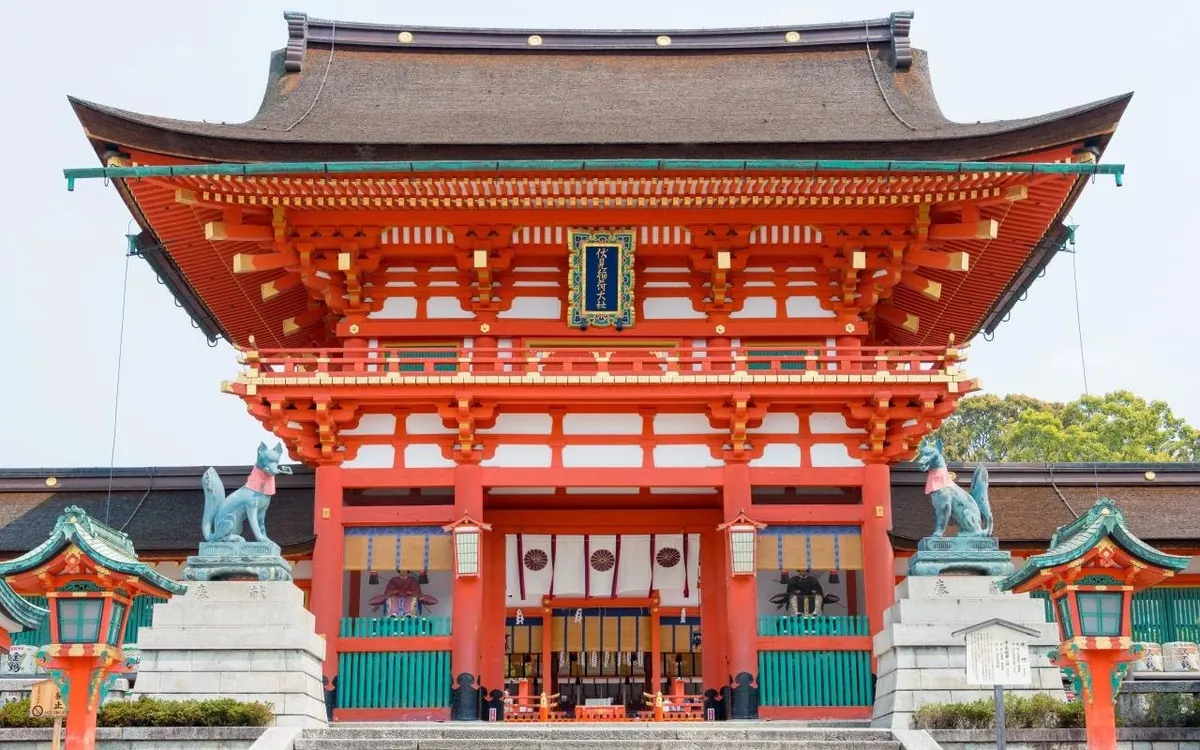
A vermilion gate the height of a house, donated in 1589 and rebuilt since. Two stone foxes flank it. Look at what they are holding — one usually has a key in its mouth.
- The main hall
Rebuilt in 1499. This is where people actually pray, and where the coach groups tend to stop and turn around.
- Senbon Torii
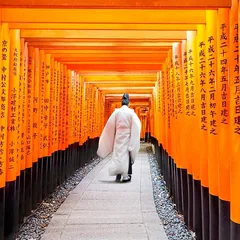
Behind the hall the path splits into two parallel tunnels of gates set so close together that the daylight between them turns orange. This is the photograph everybody comes for, and it is a hundred metres long.
- Okusha, and the weighing stones
At the top of the dense stretch, a pair of stone lanterns. Make a wish and lift the round stone on top: lighter than you expected means the wish will come; heavier means not yet.
- The mountain
Above the Okusha the crowd thins by ninety per cent within ten minutes. Yotsutsuji, the halfway crossroads, is thirty to forty-five minutes of stone steps and the first place the trees open onto the city.
The shrine is free, so what a tour actually sells is the day around it — the hour you arrive and how far you get afterwards.
Every tour that includes the shrine, compared→Every trip, current fare
Every tour that includes Fushimi Inari Shrine
Twelve tours, cheapest first, with the other stops each one reaches. The shrine itself is free on all of them — what you are paying for is everything in the other columns.
| Tour | Length | Price | Other stops | Cost per hour | Rating |
|---|---|---|---|---|---|
| Nara, Fushimi Inari & Arashiyama Bus TourThree sights, one coach, the lowest price here | 9–10 h | $50 | Nara, Arashiyama | $5.26 | 4.8 · 3,168 |
| Early Morning Fushimi Inari & ArashiyamaThe only one that beats the crowd to the gates | 6 h | $62 | Arashiyama, Kinkakuji | $10.33 | 4.9 · 1,597 |
| Kyoto by Bus: Nijo, Bamboo Grove & Fushimi InariNijo Castle and the bamboo, in English or Spanish | 11 h | $62 | Nijo, bamboo grove | $5.64 | 4.7 · 761 |
| Crowd-Free Kyoto: Fushimi Inari, Nijo & KinkakujiFive hours, and built around the early start | 5 h | $67 | Nijo, Kinkakuji | $13.40 | 4.5 · 23 |
| Private Tour: Fushimi Inari & BambooA licensed guide for your group alone | 3.5–6 h | $68 | Arashiyama bamboo | $14.32 | 4.9 · 6 |
| Kyoto Bus Tour: Fushimi, Kiyomizu, Kinkakuji & ArashiyamaThe five names everybody knows, in one day | 10 h | $81 | Kiyomizu, Kinkakuji, Arashiyama | $8.10 | 5.0 · 72 |
| Kyoto Full-Course: 10 Must-SeesTen stops for a single day in Kyoto | 9.5 h | $92 | Ten in total | $9.68 | 4.9 · 194 |
| Fushimi Inari, Kinkakuji & Bamboo GroveSix sights with every entry ticket included | 8.5–9 h | $93 | Kiyomizu, Kinkakuji, bamboo | $10.63 | 4.8 · 5,297 |
| Full-Day City Highlights Bike TourThe whole city by bicycle, lunch included | 8 h | $171 | Gion, Kiyomizu, bamboo | $21.38 | 4.9 · 56 |
| Customized Private Tour with Licensed GuideA licensed guide, and the route is yours | 4–8 h | $201 | Your choice | $33.50 | 4.8 · 523 |
| Private Highlights Tour with Guide and VehicleA car and driver for the whole day | Full day | $295 | Your choice | $36.88 | 4.9 · 121 |
| Private Highlights Tour with Guide and VehicleA driver-guide, and you write the itinerary | Full day | $415 | Your choice | $51.88 | 4.6 · 471 |
The gates
Why are there ten thousand torii gates?
Ten thousand gates, ten thousand donors, and a name painted on each one.
Because every one of them was bought by somebody. A torii at Fushimi Inari is a thank-you: a company, a family or a shopkeeper whose year went well pays for a gate and has it raised on the mountain. The black characters painted down the right-hand leg are the donor’s name and the date it went up.
The prices are public and not small. A modest gate at the narrow end of the path starts around four hundred thousand yen; the large ones near the bottom, where everyone walks, run past a million. Wood rots in the Kyoto damp, so gates are replaced continuously — walk the mountain and you will pass raw cedar posts waiting to go up beside gates whose paint is flaking off.
The colour is not decorative either. Vermilion — shu — is held to ward off evil, and the pigment traditionally contained mercury, which happened to preserve the wood. A belief and a practical fact arriving at the same colour is very Japanese, and it is the single most repeated thing any guide will tell you here.
Getting it right
Six things worth knowing before you go
None of these are on the sign at the entrance, and all six change the visit.
- There is no entrance fee, and never has been
If a page is quoting you a price to enter Fushimi Inari Shrine, it is selling you something else. Entry is free at every hour of every day.
- Arrive before eight or after five
The crowd arrives around eight with the first coaches and does not thin until late afternoon. Between ten and three the Senbon Torii is a queue.
- Go up the right-hand tunnel
The dense stretch splits into two parallel paths and rejoins a hundred metres later. Right going up, left coming down — and the left one is emptier for photographs.
- Yotsutsuji is a perfectly good turnaround
Thirty to forty-five minutes up, a view over Kyoto, and no obligation to go further. The summit has no view at all.
- Wear something you can climb in
It is stone steps, not a path. Sandals and a rented kimono make it as far as the first tunnel and no further, and you will watch people discover that.
- It is lit at night, and almost empty
The lower path has lanterns. If your flight lands late or your day filled up, this is the best remaining hour of your Kyoto trip.
Common questions
Fushimi Inari Shrine, answered
Is Fushimi Inari Shrine free?
Yes, completely. There is no entrance fee, no ticket office and nothing to book. The grounds and the mountain paths are open 24 hours a day, 365 days a year, and nobody checks anything at the entrance. Only the amulet counter and the shops along the approach keep hours, roughly 9 am to 5 pm.
How long do you need at Fushimi Inari Shrine?
Twenty minutes if you photograph Senbon Torii and turn back, which is what most coach tours allow. About ninety minutes round trip to Yotsutsuji, the halfway crossroads with the view over Kyoto. Two to three hours for the full four-kilometre loop of Mount Inari.
What is Fushimi Inari Shrine famous for?
The torii gates. About ten thousand vermilion gates line the paths up Mount Inari, and the dense double row immediately behind the main hall — Senbon Torii, meaning “thousand torii” — is one of the most photographed hundred metres in Japan.
Is Fushimi Inari a shrine or a temple?
A shrine. It is Shinto rather than Buddhist, which is why it has torii gates and fox guardians rather than a temple gate and lions. Japanese keeps the two words strictly apart; English pages often blur them, which is why so many people search for the Fushimi Inari temple.
Why are there fox statues at Fushimi Inari Shrine?
Foxes are the messengers of Inari, not the deity itself. They usually hold something in the mouth, and each object means something: a key opens the rice granary, a jewel holds the spirit, a scroll carries the teaching, and a sheaf of rice is the harvest.
When was Fushimi Inari Shrine built?
It was founded in 711 by the Hata clan and moved to the foot of Mount Inari in 816. The main hall you see today was rebuilt in 1499, after the earlier one burned during the Onin War. The gates accumulated afterwards, over centuries.
Do you need a guide at Fushimi Inari Shrine?
No — the site is free, well signed and impossible to get lost in. A guide earns the money in two situations: reading the donor inscriptions and the fox symbolism, which are invisible without Japanese, and reaching Nara or Arashiyama on the same day without three train changes. Tours start at $50.
Can you visit Fushimi Inari Shrine at night?
Yes, and it is one of the few great sights anywhere that genuinely rewards it. There is no closing time, the lower path is lit by lanterns, and there may be twenty people on it instead of two thousand.
Go deeper
More on Fushimi Inari Taisha
Torii gates Kyoto
Where the ten thousand gates are, and how to photograph them empty.
By colourThe red gates of Kyoto
What they are called, and the three other red buildings people mean.
ToursWhich tour is worth it
Six compared, and the two situations where a tour earns its price.
CostTickets and entrance fee
There are none. What a visit actually costs, and why other sights charge.
HoursWhen it is open
It never closes. Hour by hour, and when the crowd arrives.
Getting thereFrom Kyoto in five minutes
JR Nara Line, two stops, about a dollar, covered by the JR Pass.