If you do not know the name
The red gates of Kyoto: what they are called and where to find them
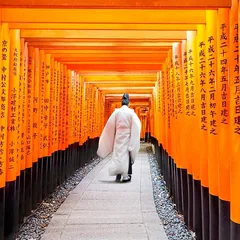
A great many people arrive at this question without the word torii. They have seen the photograph — a tunnel of red or orange gates climbing a wooded hill — and they are searching for it by colour. The answer is one place, one name, and a five-minute train ride from Kyoto Station.
Quick answer
The red gates of Kyoto are called torii, and the place with thousands of them is Fushimi Inari Taisha, a Shinto shrine in the south of the city. There are about ten thousand of them along the paths up Mount Inari. They are not red exactly but vermilion, a colour traditionally believed to ward off evil. Entry is free, the site is open 24 hours, and Inari station is two stops from Kyoto Station.
The red gates of Kyoto, at a glance
- What they are called
- Toriithe plural in English is also torii
- Where
- Fushimi Inari Taishasouthern Kyoto, at Inari station
- How many
- About 10,000not one thousand, despite the name
- The colour
- Vermilionshu — closer to orange than to red
- Cost
- Freeno ticket, at any hour
- Open
- 24 hours365 days a year
- From Kyoto Station
- ~5 mintwo stops on the JR Nara Line
- Best hour
- Before 8 amor after dark, when they are lit
- The dense stretch
- Senbon Torii"thousand torii", about 100 m long
- Guided days from
- $50the gates themselves stay free
The name
What are the red gates in Kyoto called?
Torii, in vermilion, and there are about ten thousand of them on one hillside.
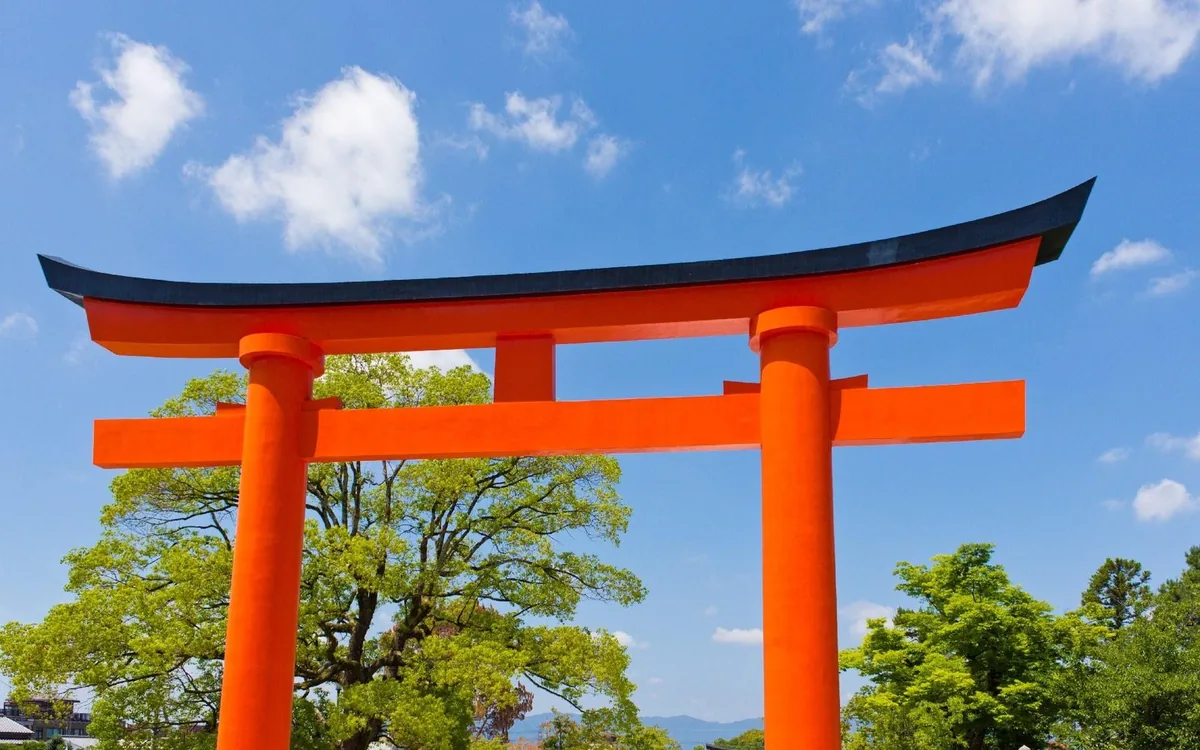
They are torii, pronounced roughly TOR-ee-ee, and the word covers every gate of that shape in Japan — from the single one at the entrance to a village shrine to the ten thousand at Fushimi Inari. It is written with characters usually read as “bird perch”, and the etymology is genuinely disputed.
The shape is standard: two uprights, a curved top beam that overhangs them, and a second straight beam passing through below it. The style at Fushimi Inari is called myojin, which is the one with the curve. A flat-topped torii is a different style and you will see those elsewhere in Japan.
The colour is not quite red. It is vermilion — shu — which sits between red and orange, and that is precisely why so many people search for “orange gates Kyoto” and just as many for “red gates Kyoto”. Both are describing the same paint.
What the colour is for is more interesting than what it is. Vermilion is held to repel evil, and the pigment used historically contained mercury, which happens to be an excellent wood preservative. Whether the belief followed the chemistry or the other way round is not recorded.
Not to be confused
Four other things people mean by "the red temple in Kyoto"
Kyoto has several vermilion buildings and they get mixed up constantly.
- Fushimi Inari Taisha — the gates
The tunnels of thousands of gates. This is the one on every postcard and in almost every search. Free, open all night, in the south of the city.
- Heian Shrine — the huge single torii
A vast vermilion gate standing over a road near the Okazaki museums, twenty-four metres high. One gate, not thousands, and often mistaken for Fushimi Inari in photographs.
- Kiyomizu-dera — the vermilion pagoda
A Buddhist temple on the eastern hills with a three-storey vermilion pagoda that photographs beautifully. It is a temple, it charges entry, and it is not the gates.
- Yasaka Shrine — the red gate at Gion
The vermilion gate at the eastern end of Shijo street, the one every Gion photograph has in the background. Also a shrine, also free, also not the tunnel.
If it is the tunnel of gates you are after, everything on this site is about that one place — and it costs nothing to walk into.
Fushimi Inari Shrine, in full→The thousand gates
Why do people call it the thousand gates when there are ten thousand?
A thousand is the famous tunnel. Ten thousand is the mountain above it.
Because of a name. The dense stretch immediately behind the main hall is called Senbon Torii, which translates as “thousand torii”. In Japanese, a thousand in this sort of construction often means “a great many” rather than a literal count — and in this case there really are more than a thousand gates in that hundred-metre stretch.
The confusion comes from what happens next. Above Senbon Torii the gates keep going, all the way round a four-kilometre loop of the mountain, and the total across the whole site is usually given as about ten thousand. So both numbers are right, and they describe different things: a thousand is the famous tunnel, ten thousand is the mountain.
The practical consequence is worth knowing. Most visitors photograph Senbon Torii and leave having seen roughly a tenth of the gates and none of the quiet. The other nine thousand are above you, on a path that almost nobody walks, and they cost the same as the first thousand: nothing.
Every trip, current fare
Tours that include the red gates
Twelve tours that stop at Fushimi Inari, cheapest first, with the other stops each one reaches. The gates themselves are free on all of them.
| Tour | Length | Price | Other stops | Cost per hour | Rating |
|---|---|---|---|---|---|
| Nara, Fushimi Inari & Arashiyama Bus TourThree sights, one coach, the lowest price here | 9–10 h | $50 | Nara, Arashiyama | $5.26 | 4.8 · 3,168 |
| Early Morning Fushimi Inari & ArashiyamaThe only one that beats the crowd to the gates | 6 h | $62 | Arashiyama, Kinkakuji | $10.33 | 4.9 · 1,597 |
| Kyoto by Bus: Nijo, Bamboo Grove & Fushimi InariNijo Castle and the bamboo, in English or Spanish | 11 h | $62 | Nijo, bamboo grove | $5.64 | 4.7 · 761 |
| Crowd-Free Kyoto: Fushimi Inari, Nijo & KinkakujiFive hours, and built around the early start | 5 h | $67 | Nijo, Kinkakuji | $13.40 | 4.5 · 23 |
| Private Tour: Fushimi Inari & BambooA licensed guide for your group alone | 3.5–6 h | $68 | Arashiyama bamboo | $14.32 | 4.9 · 6 |
| Kyoto Bus Tour: Fushimi, Kiyomizu, Kinkakuji & ArashiyamaThe five names everybody knows, in one day | 10 h | $81 | Kiyomizu, Kinkakuji, Arashiyama | $8.10 | 5.0 · 72 |
| Kyoto Full-Course: 10 Must-SeesTen stops for a single day in Kyoto | 9.5 h | $92 | Ten in total | $9.68 | 4.9 · 194 |
| Fushimi Inari, Kinkakuji & Bamboo GroveSix sights with every entry ticket included | 8.5–9 h | $93 | Kiyomizu, Kinkakuji, bamboo | $10.63 | 4.8 · 5,297 |
| Full-Day City Highlights Bike TourThe whole city by bicycle, lunch included | 8 h | $171 | Gion, Kiyomizu, bamboo | $21.38 | 4.9 · 56 |
| Customized Private Tour with Licensed GuideA licensed guide, and the route is yours | 4–8 h | $201 | Your choice | $33.50 | 4.8 · 523 |
| Private Highlights Tour with Guide and VehicleA car and driver for the whole day | Full day | $295 | Your choice | $36.88 | 4.9 · 121 |
| Private Highlights Tour with Guide and VehicleA driver-guide, and you write the itinerary | Full day | $415 | Your choice | $51.88 | 4.6 · 471 |
Common questions
The red gates of Kyoto, answered
What are the red gates in Kyoto called?
Torii. They mark the boundary between ordinary ground and sacred ground at a Shinto shrine. The ones people mean by “the red gates of Kyoto” are the roughly ten thousand at Fushimi Inari Taisha.
Where are the thousand red gates in Kyoto?
At Fushimi Inari Taisha in the south of the city. The dense stretch is called Senbon Torii and sits directly behind the main hall, about ten minutes’ walk from Inari station on the JR Nara Line.
Are the gates red or orange?
Vermilion, which sits between the two — which is why the same place is searched for as both. The Japanese word is shu, and the colour is traditionally believed to ward off evil.
How much does it cost to see the red gates?
Nothing. Fushimi Inari Taisha has no entrance fee and no ticket office, and the paths are open 24 hours a day. The train from Kyoto Station is about a dollar.
Is the red temple in Kyoto the same as the red gates?
Usually not. People searching for a red temple often mean Kiyomizu-dera, which has a vermilion pagoda and charges entry, or Heian Shrine, which has one enormous torii. The tunnel of thousands of gates is Fushimi Inari Taisha, and it is a shrine rather than a temple.
How long does it take to walk the red gates?
About ten minutes through Senbon Torii itself, thirty to forty-five minutes up to the Yotsutsuji viewpoint, and two to three hours for the full loop of Mount Inari.
Go deeper
More on Fushimi Inari Taisha
Fushimi Inari Shrine
What it is, what it costs, and the hour to arrive.
The gatesTorii gates Kyoto
Where the ten thousand gates are, and how to photograph them empty.
ToursWhich tour is worth it
Six compared, and the two situations where a tour earns its price.
CostTickets and entrance fee
There are none. What a visit actually costs, and why other sights charge.
HoursWhen it is open
It never closes. Hour by hour, and when the crowd arrives.
Getting thereFrom Kyoto in five minutes
JR Nara Line, two stops, about a dollar, covered by the JR Pass.