The foxes
The fox shrine in Kyoto: why there are foxes everywhere at Fushimi Inari
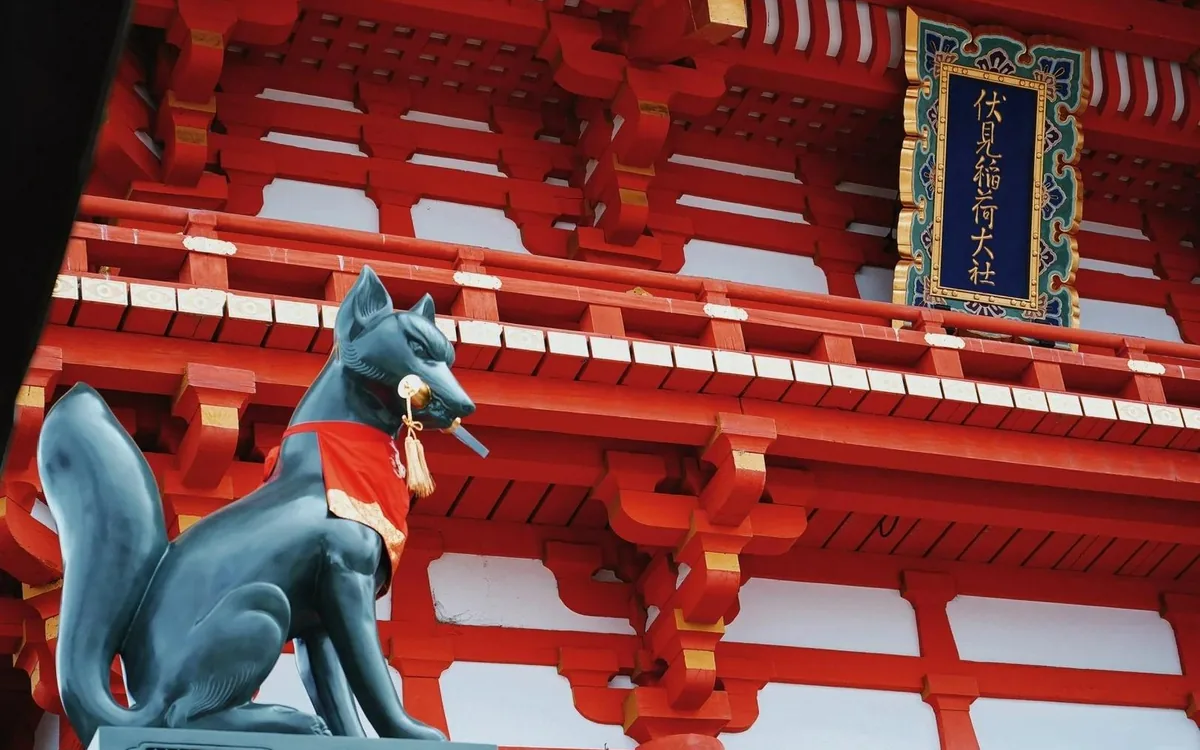
There are hundreds of them, in stone, in pairs, flanking every gate and altar on the mountain, and almost every one is holding something in its mouth. They are not the deity, they are not decoration, and what they carry is a small vocabulary that turns a walk past a hundred statues into something you can actually read.
Quick answer
The fox shrine in Kyoto is Fushimi Inari Taisha. The foxes — kitsune — are the messengers of Inari, the Shinto deity of rice and prosperity, not the deity itself. They appear in pairs at gates and altars, and each usually holds one of four objects in its mouth: a key to the rice granary, a jewel, a scroll, or a sheaf of rice. Entry is free and the site is open 24 hours.
The foxes, at a glance
- What they are
- Kitsunemessengers of Inari, not the deity
- Where
- Fushimi Inari Taishasouthern Kyoto, free to enter
- How many
- Hundredsthe count has never been published
- Usually in
- Pairsone either side of a gate or altar
- A key in the mouth
- The rice granarythe commonest of the four
- A jewel
- The spiritoften carried by the other of the pair
- A scroll
- The teachingless common, higher on the mountain
- A sheaf of rice
- The harvestthe plainest and oldest symbol
- Red bibs
- Offeringsplaced by worshippers, replaced over time
- Fox-faced plaques
- Emablank, for you to draw on
Why foxes
Why are there fox statues at Fushimi Inari?
Foxes lived in the rice fields, and Inari is the deity of rice.
Because Inari is the deity of rice, and foxes lived in the rice fields.
That is the short and probably true origin. Foxes hunted the rodents that ate the grain, so they appeared where the harvest was, and in Japanese folk belief a creature that reliably turns up where a deity’s work is being done becomes that deity’s messenger. The word is kitsune, and at Inari shrines they are specifically byakko, white foxes, invisible to ordinary sight — which is why the statues are usually pale stone rather than painted.
The distinction that gets lost in English is that the fox is not the god. People say “the fox shrine” and it is a perfectly good name for the place, but Inari is the deity and the foxes carry messages. It is the difference between a saint and an angel, and Japanese keeps it clearly.
Inari’s remit expanded over centuries in a very logical chain: rice, then the harvest, then prosperity generally, then — by the modern era — business and commerce. That is why the ten thousand gates on this mountain were paid for overwhelmingly by companies. The foxes at the gate of a shrine to rice are now guarding the patron of Japanese small business.
Reading them
What the foxes are holding, and what each one means
Once you know the four objects you cannot walk past a statue without checking.
- A key — the rice granary
The commonest, and the one on the fox beside the Romon gate at the entrance. It opens the storehouse where the harvest is kept, which is as direct a symbol of prosperity as the tradition offers.
- A jewel — the spirit
A round gem, sometimes flaming. It represents the spirit or the soul of the deity, and it is usually held by the other fox of a pair, opposite the one with the key.
- A scroll — the teaching
A rolled sutra or document. Less common than the first two and more often found on the upper mountain among the older altars.
- A sheaf of rice — the harvest
The plainest and probably the oldest of the four. Rice is the whole origin of the cult, and this is that origin stated without metaphor.
- The red bibs
Not part of the symbolism. They are offerings, placed by worshippers in the same tradition that dresses Jizo statues, and they are replaced as they weather.
- The fox-faced ema
Small wooden plaques shaped like a fox’s face, sold blank at the amulet counter. People draw an expression on them and write a wish on the back, and the racks of them near the Okusha are unlike anything at any other shrine in Japan.
The inscriptions and the symbolism are the two things a guide genuinely adds here — they are invisible without Japanese.
Tours with a guide who can read them→Where to look
Where are the best fox statues at Fushimi Inari?
The gate, the Okusha, and then the thousands of small altars nobody climbs to.
Three places, and only one of them is on the standard route.
The Romon gate, at the entrance. The pair here are the largest and most photographed on the site, and one holds a key. Everybody walks between them and a surprising number do not look up.
The Okusha, at the top of Senbon Torii. Foxes, fox-faced ema plaques by the hundred, and the weighing stones. This is the last point most visitors reach.
The upper mountain, which is where it becomes interesting. Above Yotsutsuji the path passes through clusters of otsuka — private stone altars raised by worshippers over centuries, thousands of them, each with its own miniature torii and often its own pair of small foxes. They are mossed over, crowded together under cedar, and almost nobody is there. For a lot of people this is the part of Fushimi Inari they remember.
Every trip, current fare
Tours that take you to the fox shrine
Twelve tours, cheapest first. The shrine and every fox on the mountain are free; a guide is what you are paying for, along with the rest of the day.
| Tour | Length | Price | Other stops | Cost per hour | Rating |
|---|---|---|---|---|---|
| Nara, Fushimi Inari & Arashiyama Bus TourThree sights, one coach, the lowest price here | 9–10 h | $50 | Nara, Arashiyama | $5.26 | 4.8 · 3,168 |
| Early Morning Fushimi Inari & ArashiyamaThe only one that beats the crowd to the gates | 6 h | $62 | Arashiyama, Kinkakuji | $10.33 | 4.9 · 1,597 |
| Kyoto by Bus: Nijo, Bamboo Grove & Fushimi InariNijo Castle and the bamboo, in English or Spanish | 11 h | $62 | Nijo, bamboo grove | $5.64 | 4.7 · 761 |
| Crowd-Free Kyoto: Fushimi Inari, Nijo & KinkakujiFive hours, and built around the early start | 5 h | $67 | Nijo, Kinkakuji | $13.40 | 4.5 · 23 |
| Private Tour: Fushimi Inari & BambooA licensed guide for your group alone | 3.5–6 h | $68 | Arashiyama bamboo | $14.32 | 4.9 · 6 |
| Kyoto Bus Tour: Fushimi, Kiyomizu, Kinkakuji & ArashiyamaThe five names everybody knows, in one day | 10 h | $81 | Kiyomizu, Kinkakuji, Arashiyama | $8.10 | 5.0 · 72 |
| Kyoto Full-Course: 10 Must-SeesTen stops for a single day in Kyoto | 9.5 h | $92 | Ten in total | $9.68 | 4.9 · 194 |
| Fushimi Inari, Kinkakuji & Bamboo GroveSix sights with every entry ticket included | 8.5–9 h | $93 | Kiyomizu, Kinkakuji, bamboo | $10.63 | 4.8 · 5,297 |
| Full-Day City Highlights Bike TourThe whole city by bicycle, lunch included | 8 h | $171 | Gion, Kiyomizu, bamboo | $21.38 | 4.9 · 56 |
| Customized Private Tour with Licensed GuideA licensed guide, and the route is yours | 4–8 h | $201 | Your choice | $33.50 | 4.8 · 523 |
| Private Highlights Tour with Guide and VehicleA car and driver for the whole day | Full day | $295 | Your choice | $36.88 | 4.9 · 121 |
| Private Highlights Tour with Guide and VehicleA driver-guide, and you write the itinerary | Full day | $415 | Your choice | $51.88 | 4.6 · 471 |
Common questions
The fox shrine, answered
Why are there foxes at Fushimi Inari?
Foxes are the messengers of Inari, the Shinto deity of rice and prosperity. Foxes lived in the rice fields and hunted the animals that ate the grain, so folk belief attached them to the deity of the harvest.
What is the fox shrine in Kyoto called?
Fushimi Inari Taisha. It is in the south of the city, it is free to enter, and it is open 24 hours a day. It is also the head shrine of roughly thirty thousand Inari shrines across Japan.
What do the foxes hold in their mouths?
One of four things: a key, which opens the rice granary; a jewel, representing the spirit; a scroll, representing the teaching; or a sheaf of rice, representing the harvest itself.
Is the fox the god at Fushimi Inari?
No. Inari is the deity; the foxes are messengers. English usage blurs this because “the fox shrine” is such a natural name for the place, but Japanese keeps the two distinct.
Why do the fox statues wear red bibs?
They are offerings left by worshippers, in the same tradition that dresses roadside Jizo statues. They are not part of the fox symbolism and they are replaced as they weather.
What are the fox-faced wooden plaques?
Ema — votive tablets. At Fushimi Inari they are shaped like a fox’s face and sold blank, so visitors draw an expression on the front and write a wish on the back. The racks of them near the Okusha are unique to this shrine.
Is there a kitsune temple in Kyoto?
People searching for a kitsune temple almost always mean Fushimi Inari Taisha, which is a shrine rather than a temple. It is Shinto, it is free, and it is the fox shrine everybody means.
Go deeper
More on Fushimi Inari Taisha
Fushimi Inari Shrine
What it is, what it costs, and the hour to arrive.
The gatesTorii gates Kyoto
Where the ten thousand gates are, and how to photograph them empty.
By colourThe red gates of Kyoto
What they are called, and the three other red buildings people mean.
ToursWhich tour is worth it
Six compared, and the two situations where a tour earns its price.
CostTickets and entrance fee
There are none. What a visit actually costs, and why other sights charge.
HoursWhen it is open
It never closes. Hour by hour, and when the crowd arrives.